Blog
AI character consistency in 2026: how reference images keep a cast on model
Why AI characters drift, how seeds, reference images and trained adapters compare, and the exact references MangaMade sends with every panel.
Published October 8, 2026 · 6 min read
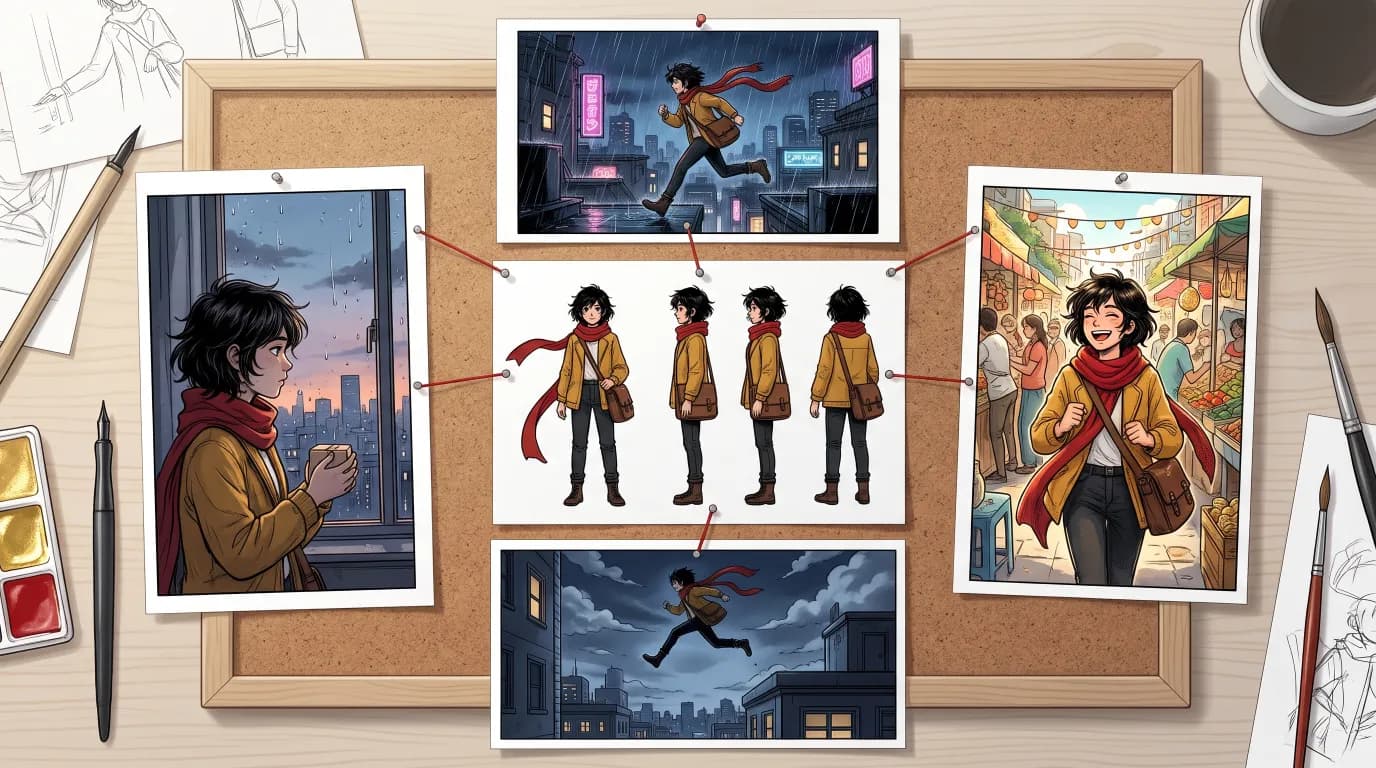
Consistent characters were the hardest problem in AI comics for years. Ask for the same hero twice and you got two cousins. In 2026 that changed, because the image models people talk about most now accept several reference pictures in a single request and actually follow them. This article explains why characters drift, compares the three ways creators fight it, and shows exactly how MangaMade uses multi-reference models to keep a whole cast on model, prompt lines included.
Why AI characters drift
An image model has no memory between pictures. Each panel starts from its own prompt, and words leave a lot open: a young woman with short hair and a red scarf fits thousands of faces. Whatever the prompt does not pin down, the model decides again every time, and the decisions it makes for an unusual angle or a strong expression are the ones most likely to change the face. In a single illustration nobody notices. Across forty panels, readers notice everything.
Three ways to keep a character consistent
Creators use three methods, often together:
- A fixed seed: the same random starting point for every picture. It keeps the overall look close as long as the prompt barely changes, and falls apart as soon as the pose, angle or scene does, which in comics is every panel.
- Reference images: pictures of the character sent along with the prompt, which the model is asked to match. Strong and immediate, with no training, and it works for any new character on the day you design them.
- A trained adapter: a small add-on trained on one character, often from fifteen to thirty pictures, which then draws that character very reliably. The strongest method, but every new character costs a dataset, training time and a retrain when the design changes.
What changed recently is the middle option. Earlier models took one reference at best and treated it loosely. The current generation accepts several reference images per request, understands which picture is which, and holds faces, hair and outfits far more faithfully. That is what makes reference images good enough for a full chapter without training anything.
How MangaMade uses multi-reference models
MangaMade chose references over training: your cast should be usable the minute you design it, and a change of outfit should not mean a retrain. Every panel is drawn against a numbered stack of references, in this order:
- The model sheet of each character in the panel, up to four: one image with a turnaround and four expressions, drawn once per character. A character without a sheet falls back to their first reference image.
- The series’ style reference: one sample panel of your story’s world, so line weight, shading and palette stay the same from page to page.
- The continuity reference: the nearest earlier panel of the same scene that already has a drawing, so the room, the clothes and the light carry over.
That makes at most six references for one panel. You can also give each character up to four reference images of your own, such as art you drew or may use, and the model sheet is drawn from them.
What the prompt actually says
References only work if the prompt says what each one is for. Here is the shape of a real panel prompt in MangaMade, for a medium shot of a courier called Mira who appears in a continuing rooftop scene:
Medium shot. Setting: harbour rooftops at dusk.
Mira as in reference 1: leaping between roofs, determined, left of the frame.
Action: she jumps the gap, scarf streaming behind her.
Draw in the style of reference 2.
This panel follows reference 3 in the same scene: keep places, clothes and light consistent.
No text, letters, numbers, speech balloons, captions, sound effects, signatures, logos or watermarks anywhere in the image.- Each character is tied to a numbered reference, with the pose, expression and place in the frame from the script.
- The style line points at the style reference, never at a named artist or studio.
- The continuity line only appears when an earlier panel of the scene is drawn, which is why drawing a scene’s first page before the rest helps.
- The last line is on every panel: the drawing carries no text, because dialogue, captions and sound effects are MangaMade’s own lettering layer.
When a panel still drifts
References reduce drift; they do not abolish it. Extreme angles, tiny figures in wide shots and crowded panels are still where details slip. When that happens, redraw the panel with a short note, such as “scar on her left cheek, as on the sheet”. A redraw costs what the panel costs, 1 credit at 1K or 2 for a splash page, every attempt stays in the panel’s history, and a failed drawing returns its credit. If the same detail slips again and again, fix the source instead: redraw the model sheet or make the appearance description more concrete.
Writing characters that hold up
The best reference still needs a clear design behind it. A few habits make any multi-reference model more reliable:
- Give each character one detail that survives a small panel: a red scarf, a white streak of hair, a scar.
- Keep silhouettes distinct, so two characters are never told apart by the face alone.
- Write appearance as things a camera sees, in English: apparent age, build, hair, outfit and distinguishing marks.
- Check the model sheet before drawing panels, because every panel copies it, mistakes included.
- Use one wording per place, so the continuity reference finds the earlier panel of the same scene.
In credits, a cast costs little: 2 per model sheet and 1 for the style reference, both drawn once per series and reused by every chapter, then 1 per panel. A new account starts with 15 free credits, valid for 30 days, enough to draw a style reference, a sheet and a first page.
Questions this answers
- How do I keep an AI character consistent across images?
- Send pictures of the character with every request instead of relying on words alone. A model sheet with several angles and expressions is the best single reference, combined with a style reference and, for comics, an earlier panel of the same scene.
- Do I need to train a model on my character?
- Not anymore for most comics. Multi-reference image models hold a character well from a model sheet alone. Training an adapter is still the strongest option, but it needs many images and a retrain whenever the design changes.
- How many reference images does MangaMade use per panel?
- Up to six: the model sheets of up to four characters in the panel, the series’ style reference and the nearest earlier drawn panel of the same scene.
- Why does MangaMade forbid text in the generated image?
- Text drawn by an image model is often misspelled and cannot be edited or translated. MangaMade letters every page itself on a separate layer, so the drawing is asked to contain no text at all.
- Which image models does MangaMade use?
- MangaMade uses current multi-reference image models and can move between them as better ones appear, so it does not tie a series to one model. What stays the same is the reference stack and the prompt rules described here.
Make your next chapter
Turn your story into lettered pages: model sheets for your cast, AI-drawn panels and exports in PNG, PDF, CBZ or webtoon.
Start freeKeep reading
- How to translate your manga or webtoon with AI, without redrawing it
- Make manga with an AI agent: the MangaMade MCP server and API
- Manga panel layout: how to storyboard a page that reads
- How to make a webtoon: a step-by-step guide for beginners
- How to make a manga chapter with AI, step by step
- How to keep characters consistent across panels
- Manga vs manhua vs webtoon: formats and reading direction
- Speech balloons and lettering basics for manga and comics
- How to export a comic for vertical scroll and for print
- AI art and copyright: what you own when you make comics with AI
- AI manga generator: how to turn text into manga pages